1 3. Fee Distribution Flow
The MetaSoilVerse Protocol ($MSVP) employs a dynamic, modular fee distribution system that aligns economic incentives with long-term sustainability, ecosystem growth, and token utility. This model ensures that every transaction , whether asset onboarding, leasing, staking, yield redemption, or cross-chain operations , contributes to the protocol ’ s health through smart contract-governed logic trees.
1 3.1 Fee Sources
Fees are levied at various protocol interaction points, including:
Asset Tokenization Fee Charged during the RWA onboarding process to cover oracle attestation and NFT/SFT minting gas.
Leasing Fee A percentage of yield generated from real-world leasing flows (e.g., factory, real estate, solar panel).
Vault Exit Fee Slippage-reserve withdrawal fee applied on early exits from staking/yield vaults.
Cross-Chain Messaging Fee Charged during L0 bridge interactions (LayerZero/Axelar).
Governance Proposal Fee Collected when submitting proposals to reduce spam and align voting power with stake.
1 3.2 Fee Routing Logic
All collected fees are routed using a smart contract-based transaction logic tree . This logic ensures deterministic, real-time allocation across multiple protocol components.
T ransaction Fee Flow (Tx)
Let:
F_tx = Total transaction fee (in $MSVP)
F_burn = Portion to be permanently burned
F_treasury = Portion sent to the protocol treasury
F_referral = Portion rewarded to referrer (if any)
F_vault = Portion injected into staking vault as yield
The system satisfies the following invariant:
F_tx = F_burn + F_treasury + F_referral + F_vault
Default Distribution (configurable via governance):
| Component | % of Fee | Functionality |
|---|---|---|
| Burn | 20% | Permanent supply reduction (deflationary) |
| Treasury | 30% | Operational and ecosystem expenses |
| Referral | 15% | Community growth via on-chain referrals |
| Vault Rewards | 35% | Recycled into staking & leasing yield vaults |
1 3.3 Fee Distribution Logic Tree (Simplified)
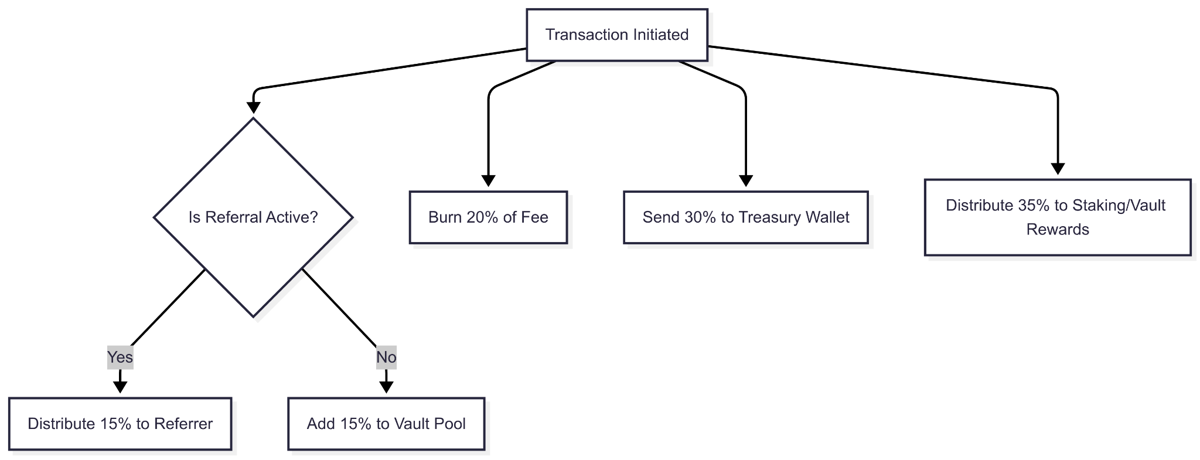
Smart contracts handle all allocations in a single atomic call.
1 3.4 Referral Fee System
The multi-level referral mechanism tracks wallet-based referrals via Merkle tree registration. Upon transaction, the smart contract dynamically checks referral lineage and assigns rewards proportionally:
Level 1: 10%
Level 2: 5%
If no referral is detected, the corresponding percentage is re-routed to vault pools .
1 3.5 Deflationary Design
The burn component ensures that every protocol transaction reduces the effective circulating supply , creating upward price pressure as protocol activity increases.
Let:
T = Total supply = 2 00B MSVP (fixed)
B_t = Total burned at time t
C_t = Circulating supply = T - B_t - Vested
Every transaction contributes:
C_t+1 = C_t - F_burn
Over time, this dynamic introduces automated scarcity aligned with usage volume , similar to EIP-1559 in Ethereum but tailored for asset-based economies.
1 3.6 Governance-Controlled Fee Parameters
Fee % splits can be rebalanced by MSVP DAO through proposals and votes.
Burn %, Referral %, and Vault Reward % can be adjusted per sector.
Example: Carbon Credit sector may set 50% to burn due to green alignment.